Introduction
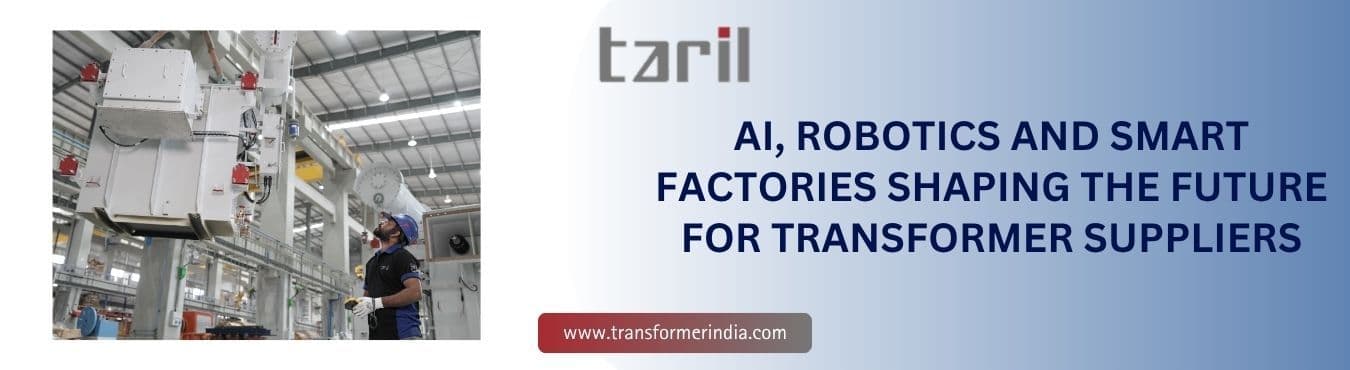
Order books tell the story. The International Energy Agency's 2025 grid report found that average transformer lead times have roughly doubled since 2021, with manufacturers carrying record backlogs as grid renewal, renewables and data centres compete for the same capacity. Global transformer manufacturers cannot simply throw more floor space at the problem — new plants take years to commission. Instead, many are turning to three practical tools: AI software that optimises designs and screens test data, robots that take on repetitive stages such as core cutting and materials handling, and connected factory systems that trace every unit from drawing board to dispatch.
How Is AI Changing the Way Global Transformer Manufacturers Work?
AI enters transformer production at three main points: design optimization, test data analysis and plant maintenance. At the design stage, optimisation software evaluates thousands of core and winding configurations, balancing losses, cost and size, before a single sheet of steel is cut, and returns a shortlist for the design engineer to validate.
The second application sits on the test floor. Every finished unit generates a trail of measurements: insulation resistance, load losses, partial discharge readings, impulse waveforms. Machine learning models trained on years of that history can flag readings that pass the standard yet sit oddly against comparable units — a partial discharge count creeping above the norm for that design, say, or losses drifting from those of sister units. Both are early signatures of a defect, caught while it is still cheap to fix.
The third use is plant maintenance. Sensors tracking vibration, temperature and wear on winding machines, ovens and vacuum plants warn engineers before a breakdown halts production, protecting throughput at a time when every production slot is spoken for. None of this replaces experienced people; it gives them better information, sooner.
What Role Does Robotics Play in Building Oil-Filled Transformers?
Robotics has clear limits in transformer manufacturing. Much of the work - coil assembly, insulation fitting, tanking - remains genuinely difficult to automate, and oil-filled transformers in particular involve heavy, variable, one-off assemblies. Robotics tends to add value in specific, repeatable stages rather than across the whole line:
- Core cutting and stacking. Automated lines can cut and lay grain-oriented steel laminations with a consistency that reduces core losses and material waste.
- Winding assistance. Semi-automated winding machines maintain uniform tension and spacing, particularly on distribution-class units built in higher volumes.
- Handling and logistics. Automated guided vehicles move heavy components through the plant, cutting manual handling risk and idle time.
- Vision-based inspection. Camera systems check welds, clearances and finishes against tolerances that tire human eyes over a long shift.
The pattern is collaboration rather than replacement - machines take on the repetitive and the hazardous, while engineers keep the judgement calls.
Why Do Smart Factories Matter for Special Transformers?
Standard products benefit from automation; special transformers - rectifier, furnace, traction and other engineered-to-order units - benefit from connectivity. When design files, material tracking, test benches and quality records sit in one digital thread, a plant can build a one-off unit with the same traceability as a production run. A digital twin - a simulation model built from the unit's design data - lets engineers check thermal behaviour and short-circuit forces in software before steel is cut, so errors surface on screen rather than on the test floor.
For buyers, this means better documentation, earlier visibility of delays, and test data that can be reviewed rather than taken on trust. These benefits are particularly valuable for complex, customised orders where a single error is expensive.
What Should Buyers Expect from High Voltage Transformer Suppliers in This New Era?
When comparing high voltage transformer suppliers, evaluate five areas — data handling, automation, design verification, delivery reliability and workforce skills - with these question:
1. How is test data captured and shared? Digitally recorded, traceable results are worth more than a summary certificate. 2. What does the plant automate - and what does it deliberately keep manual? A credible supplier can explain both. 3. How is design verified? Simulation and type-test evidence together tell you more than either alone. 4. Can they hold delivery dates? Digitised planning tends to show up in schedule reliability, which matters when global lead times are stretched. 5. How are people trained? Smart factories still run on skilled workers; investment in training is a good proxy for long-term quality.
No single answer settles the choice, but together they reveal how seriously a manufacturer takes its own modernisation.
Where Does TARIL Stand as the Industry Modernises?
Transformers & Rectifiers (India) Ltd (TARIL) has been manufacturing since 1981, with more than 18,000 installations across 40+ countries and a product range spanning power transformers up to 1200 kV and 1000 MVA alongside rectifiers, furnaces and other special transformers. The company operates multiple manufacturing plants, tests in-house to IEC standards, and produces both volume orders and one-off engineered designs, the mix of capabilities that AI-driven design, automation and digital traceability are built on.
AI in design and testing, robots on repeatable stages, and a digital thread through every order, these changes are reshaping how transformers are built and bought. But the direction is clear, and if you are weighing suppliers for an upcoming project, the TARIL team is happy to talk through how they build, test and deliver.
FAQs
Will AI and robots replace workers in transformer factories?
Unlikely, at least in any near term. Transformer building still depends on skilled assembly and engineering judgement. Automation is taking over repetitive and hazardous tasks, while people move towards supervision, analysis and quality roles.
Are robotically built transformers better quality?
Not automatically. Automation improves consistency in stages like core stacking and inspection, but overall quality still depends on design, materials and testing discipline.
Do smart factory technologies make transformers more expensive?
Not necessarily. Digitalisation can reduce waste, rework and delays, which offsets investment costs over time — though the balance varies by product and plant.
Does TARIL build special transformers as well as standard units?
Yes. TARIL manufactures rectifier, furnace and other engineered-to-order special transformers alongside its power and distribution range.