August 26, 2026
3:49 min read

This article explains how smart transformers can improve transformer visibility, maintenance planning, and renewable integration in India. It also covers industrial applications, grid digitalisation, and the technical questions that utilities, EPC contractors, and plant operators should ask before selecting a solution.
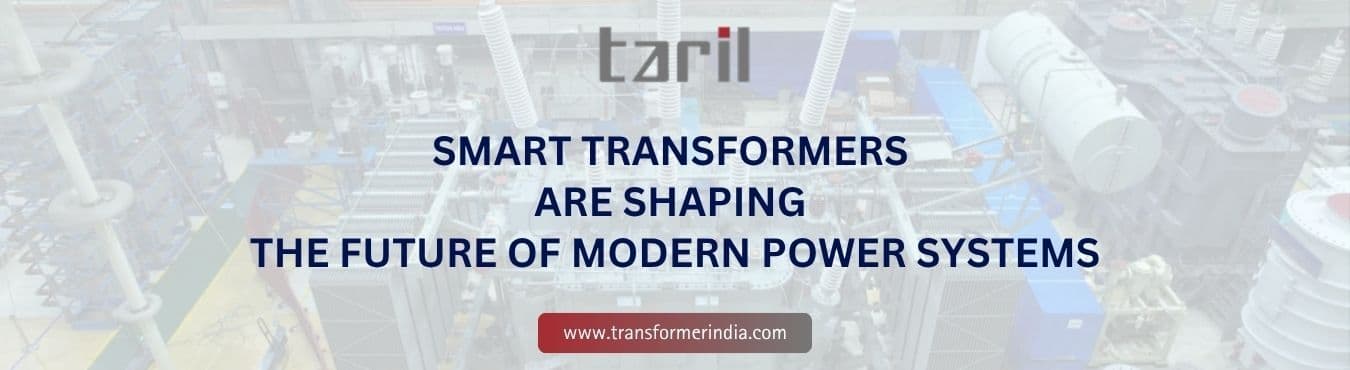
As of December 2025, India’s transmission network had crossed 5 lakh circuit kilometres at 220 kV and above, supported by 1,407 GVA of transformation capacity. At the same time, renewable generation, rooftop solar, battery storage, and changing industrial demand are making power flow less predictable. These conditions can increase thermal cycling, voltage variation, reverse power flow, and stress on transformer cooling and insulation systems.
This is where smart transformers become relevant. By combining core transformer engineering with condition monitoring, communication, and diagnostics, they help utilities and industrial operators understand how an asset is performing while it remains in service.
For Transformers & Rectifiers (India) Limited (TARIL), the focus is not simply on adding sensors, but on matching monitoring and control features to the transformer’s actual duty. To understand that difference, it is important to first look at what separates a smart transformer from a conventional unit.
A smart transformer combines voltage transformation with digital sensing, communication, and, where the design permits, automated control. The term may describe a conventional transformer fitted with monitoring equipment or a power-electronic transformer with active conversion functions.
Depending on the application, monitoring may track:
The operating chain is:
Sense → analyse → communicate → alert or act
IEC 61850 supports interoperable communication between intelligent electronic devices used in utility and substation automation, enabling measurements and alarms to reach protection, SCADA, and asset management systems.
A transformer does not become intelligent merely because a meter is installed at its terminals. Value depends on sensor quality, data interpretation, and whether each alarm leads to a defined response.
By the end of 2025, India’s non-fossil installed capacity had reached approximately 266.79 GW, accounting for 51.93% of the country’s total installed power capacity. During 2025 alone, India added more than 48.43 GW of renewable-energy capacity.
These changes create:
Smart transformers do not replace protection relays, inverters, STATCOMs, storage, or SCADA. They provide transformer-level evidence that helps those systems and operators respond with better context.
Continuous monitoring cannot prevent every failure, but it can expose problems earlier.
A rising, winding hot-spot temperature may not immediately operate as protection. Compared with load current, ambient temperature, top-oil temperature, and fan status, however, it may indicate restricted cooling, fan failure, or abnormal local heating.
Monitoring can also reveal moisture or dissolved-gas trends, unusual tap changer behaviour, vibration changes, and repeated operation near thermal limits. CIGRE has documented models that interpret transformer sensor and SCADA data for condition assessment rather than relying on isolated readings.
This supports three maintenance approaches:
Calendar-based: Work follows fixed intervals.
Condition-based: Measured deterioration triggers service.
Predictive: Trends estimate when intervention may be required.
The aim is not to generate more alarms. It is to give operations and maintenance teams information they can use.
Smart transformer technology supports distribution grids, renewable substations and demanding industrial processes by improving asset visibility, condition assessment, fault analysis and maintenance planning across different transformer applications and operating environments.
Utilities can use transformer-level data to identify overload frequency, voltage issues, phase imbalance, and assets needing priority inspection. When comparing distribution transformer manufacturers, buyers should assess sensor compatibility, communication options, losses, and retrofit support.
A monitored high-voltage transformer can provide loading, oil, bushing, cooling, and tap changer information for substations, renewable pooling stations, and large industrial connections. Time-aligned records also help determine whether an incident began inside the transformer or elsewhere in the network.
A furnace transformer may face rapid load swings, harmonics, high secondary currents, and repeated tap operations. Monitoring temperature, current, vibration, and cooling performance helps steel plants and foundries separate normal process duty from developing equipment problems.
TARIL manufactures power, furnace, rectifier, distribution, and special transformers, alongside reactors and services covering repair, refurbishment, diagnostics, oil analysis, and asset-health monitoring. Its power-transformer range extends to the 1,200 kV class and 1,000 MVA.
Solar and storage subject transformers to variable output, reverse flow, and repeated charging or discharging cycles. Monitoring voltage, loading and thermal response helps operators assess whether abnormal behaviour comes from the transformer, inverter settings, generation profile or wider network.
A smart transformer is not automatically a solid-state transformer. A sensor-equipped conventional unit remains electromagnetic. A solid-state transformer uses semiconductor stages and may incorporate AC-to-DC converters, a DC link, and inverters for storage, EV charging, or DC microgrids.
Buyers should compare transformer companies on lifecycle performance, not only initial price. A capable electrical transformer manufacturer should explain whether its design, monitoring, and service approach fit the intended duty cycle before discussing:
For TARIL, assessment begins with voltage class, MVA rating, load cycle, fault level, cooling, installation conditions, and service strategy. Monitoring should follow the application, not a standard accessory list, so the selected functions match the duty more closely.
By December 2025, RDSS had delivered 3.77 crore consumer meters, 12.56 lakh distribution-transformer meters and 1.58 lakh feeder meters. Across government schemes, 5.28 crore smart meters had been installed nationally.
A DT meter is not a complete smart transformer, but it creates useful energy-accounting and communications infrastructure.
RDSS has an approved outlay of ₹3,03,758 crore, including estimated central government support of ₹97,631 crore. It covers metering, distribution upgrades, training and enabling activities, not smart transformers alone.
For utilities, better transformer data can improve fleet prioritisation. EPC contractors can specify clearer interfaces between transformers, protection, and SCADA.
Renewable developers can assess variable loading and reverse flow, while industrial plants can plan maintenance around production needs.
The central question is not whether transformer data can be collected. It is whether that data can be trusted, interpreted, and converted into practical maintenance, loading, and grid-control decisions.
Organisations planning a new transformer, retrofit or monitoring programme can consult TARIL’s engineering team to review duty cycle, cooling, integration and lifecycle-service needs. An early technical review can help select functions that genuinely support the application.
What is a smart transformer?
It is a transformer combined with sensors, communications, and data analysis. Some power-electronic designs also provide active voltage or AC/DC control.
Can an existing transformer be upgraded?
Many units can be retrofitted with temperature, current, vibration, oil, moisture, or partial-discharge monitoring, subject to design and access limitations.
Is a DT meter the same as a smart transformer?
No. A DT meter measures electrical quantities at the connection point. A fuller system may also monitor internal temperature, oil, moisture, cooling, and tap changer condition.
Do conventional transformers convert AC into DC?
No. They change the AC voltage. AC-to-DC conversion requires a rectifier or another power-electronic stage.