August 25, 2026
5:35 min read

The UAE plans to triple its renewable energy contribution by 2030 and reach net zero by 2050, and none of it happens without the electrical transformer. Every solar park, wind farm and hydrogen facility needs transformers to move power from where it is generated to where it is used. In this blog, we look at why transformers sit at the heart of the UAE's energy transition, what actually makes a transformer sustainable, how global transformer manufacturers are adapting, and what buyers in the Emirates should look for in a supplier.
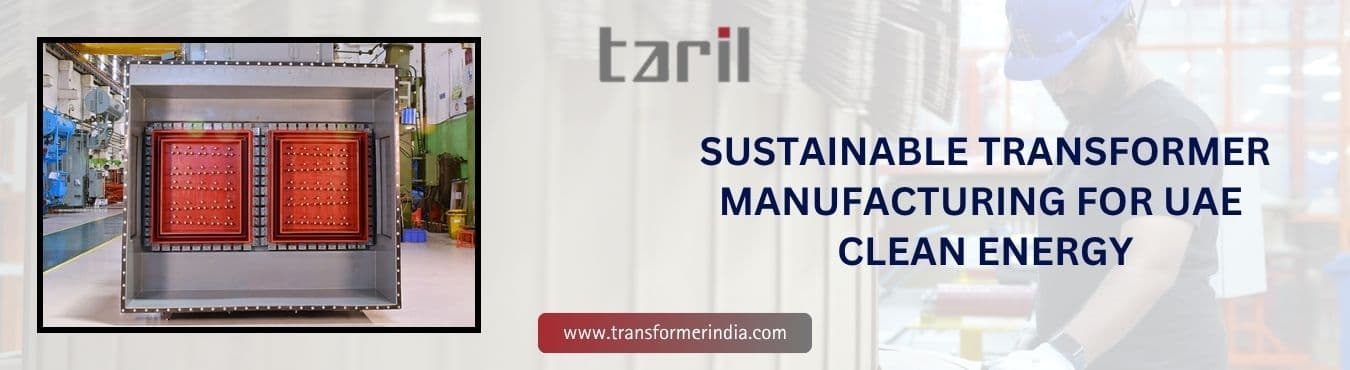
The UAE Energy Strategy 2050 targets a clean energy share of around 30 per cent by 2030, backed by investments of AED 150–200 billion, with net-zero emissions from the energy and water sectors by mid-century. Behind major projects like the Mohammed bin Rashid Al Maktoum Solar Park and Al Dhafra Solar PV lies a quieter story: the grid equipment that makes clean power usable. That is where sustainable manufacturing by an experienced electrical transformer manufacturer matters enormously.
Renewable generation changes the shape of a grid. Instead of a handful of large gas-fired plants, power now flows from sprawling solar parks in the desert, nuclear units at Barakah, and soon, green hydrogen facilities. Each of these assets needs a power transformer to step voltage up for transmission, and thousands of distribution transformers to step it back down for homes, industry and data centres.
The scale is striking. Al Dhafra alone delivers 2 GW from a single site, while Dubai's flagship solar park is heading towards 5 GW by 2030. Connecting that capacity means new substations, new transmission corridors and a substantial pipeline of transformer orders - at a time when global transformer manufacturers are already stretched by demand from grid upgrades worldwide. Supply reliability has become as important as technical specification.
Sustainability is about much more than one feature or specification. In practice, it runs through everything — the materials a transformer is built from, how it is engineered for its environment, and how it behaves over a service life of thirty years or more. For a genuinely sustainable electrical transformer, four levers matter most:
None of these features are new on their own, but taken together, these choices decide the footprint a grid carries for decades.
The market has shifted. Utilities and developers in the UAE no longer buy on price and delivery time alone; tenders increasingly ask about loss performance, insulating fluids and the manufacturer's own environmental practices. In response, leading producers have invested in low-loss core technology, ester-ready designs, and digital monitoring that flags problems before they become failures - extending asset life and avoiding the waste of premature replacement. Capacity matters too. With lead times for large units stretching worldwide, power transformer suppliers with genuine manufacturing depth - multiple plants, in-house testing to IEC standards, and the ability to build up to the highest voltage classes - are better placed to keep UAE projects on schedule.
If you are procuring for a renewable project, substation or industrial facility in the Emirates, a few practical checks go a long way:
Transformers & Rectifiers (India) Ltd (TARIL) has been building transformers since 1981 and today ranks among India's largest manufacturers, with more than 18,000 installations across 40+ countries, including the UAE. The company produces power transformers up to 1200 kV and 1000 MVA, alongside rectifier, furnace, distribution and special transformers. Ester-filled options, energy-efficient designs and rigorous IEC-aligned testing are at the core of its approach, a natural fit for a market moving as quickly towards clean energy as the Emirates.
For UAE utilities and developers planning the next phase of the energy transition, the message is straightforward: choose partners who treat sustainability as engineering, not marketing — and if you are scoping a project, the TARIL team is just a conversation away.
Why are transformers so important to the UAE's renewable energy plans?
Solar, nuclear and hydrogen projects all generate power that must be stepped up for transmission and stepped down for use. Without sufficient transformer capacity, new clean generation simply cannot connect to the grid.
Are ester-filled transformers worth the extra cost?
In many cases, yes. Esters are biodegradable, have a much higher fire point than mineral oil, and can extend insulation life — valuable near solar parks, urban substations and coastal sites.
How do low-loss transformers help meet climate targets?
Every unit of energy lost as heat in a transformer must be generated somewhere. Reducing core and winding losses across thousands of units cuts national emissions and supports the UAE's 2030 grid emission targets.
Does TARIL supply transformers to the UAE?
Yes. TARIL exports to more than 40 countries, including the UAE, and offers customised designs suited to Gulf operating conditions.