August 25, 2026
5:35 min read

As grids absorb more renewable energy and transmission networks expand, dynamic reactive power compensation has evolved from a niche solution to an operational necessity. STATCOM has become a crucial technology for preventing voltage collapse. Widely used in transmission networks, renewable plants, and industrial systems, STATCOM plays a key role in ensuring reliable and efficient power delivery.
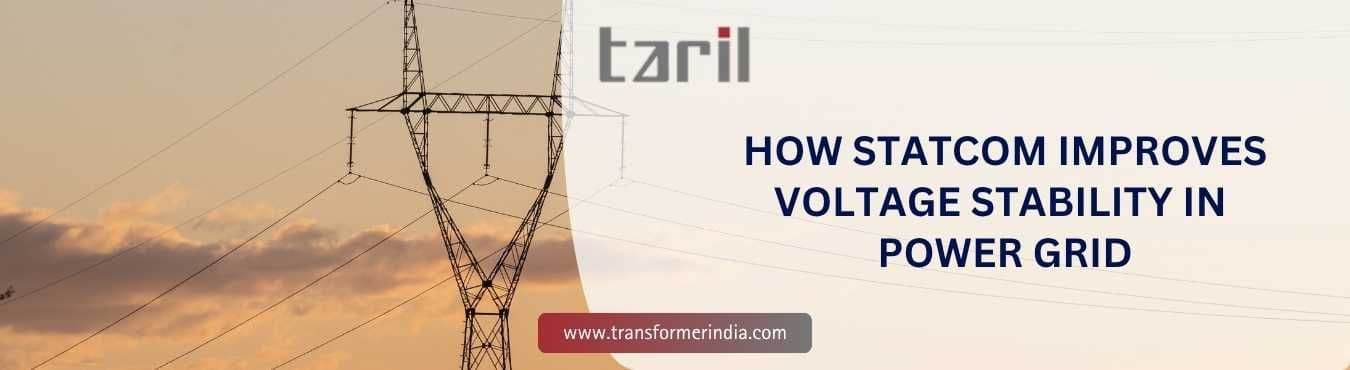
Modern power grids are under strain. In India and across global markets, rapid growth in renewable energy, long transmission networks, and fluctuating demand have made voltage control a major engineering challenge. Utilities and EPC contractors need fast-acting solutions for dynamic voltage control to prevent instability, support fault ride-through, and comply with grid codes.
Today's networks demand faster, smarter, and more dynamic control. That is precisely where STATCOM enters the equation.
Maintaining stable voltage levels is essential for a reliable power supply. Voltage stability depends on the continuous balance of reactive power at every node in the network.
However, modern grids face several challenges:
The result is a grid that oscillates rather than sits in a steady state, and a grid that oscillates needs continuous, fast correction.
STATCOM stands for Static Synchronous Compensator. It is a shunt-connected FACTS device used on power grids to help control voltage.
It is built around a Voltage Source Converter (VSC), which is a type of electronic converter that can both absorb and supply reactive power. Unlike traditional compensation systems, STATCOM responds almost instantly to voltage fluctuations.
This fast response allows it to maintain voltage stability even under rapidly changing load or generation conditions, making it highly effective in modern power networks.
STATCOM enhances voltage stability through dynamic and continuous control of reactive power.
Unlike capacitor banks, STATCOM maintains full reactive current output even during deep voltage sags - delivering reactive support exactly when grid stress is highest.
| Parameter | STATCOM | SVC | Capacitor Banks |
|---|---|---|---|
| Response Time | Very fast - electronic control (sub-cycle to ~1 cycle) | Fast but limited by thyristors gating (≈1–3 cycles) | Slow — mechanical switching (seconds) |
| Performance at Low Voltage | Maintains full reactive current even under deep voltage sags | Reactive output reduces as voltage drops (less effective) | Fixed steps; output drops with voltage (quadratic effect) |
| Control Type | Continuous, fully dynamic control | Continuous but limited by thyristors firing angles | Discrete switching (on/off steps) |
| Footprint & Harmonics | Relatively compact, lower harmonic content | Larger, can require filters to mitigate harmonics | Simple but can trigger resonance if not properly tuned |
| Transient Stability Support | Superior - fast and active support | Good - but slower and less flexible | Limited - only passive support |
STATCOM is widely deployed across both Indian and global power systems.
Solar parks and wind farms in Gujarat, Rajasthan, and Saudi Arabia require dynamic voltage support at grid interconnection points.
PGCIL and state transmission utilities in India deploy STATCOM at critical 400 kV and 220 kV substations to maintain voltage stability and prevent voltage collapse on heavily loaded transmission corridors.
Steel plants, arc furnaces, and aluminium smelters have rapidly fluctuating reactive demand. These are commonly found in the industrial belts and in industrial zones across the GCC region.
High-density load centres in metro areas require voltage support during peak demand periods without large equipment footprints.
These applications highlight the growing importance of STATCOM in maintaining stable and reliable power systems.
Transformers play a critical role in integrating STATCOM with the power grid.
Without the right transformer design, a STATCOM system cannot deliver effective voltage regulation or grid support.
As leading global transformer manufacturers, companies like TARIL that manufacture power transformers across voltage classes up to 1200 kV and 1000 MVA bring the depth of engineering required for such critical, application-specific units.
Selecting the right STATCOM solution requires careful evaluation of grid and system requirements.
Engineers typically consider:
A well-designed STATCOM solution, supported by the right transformer ecosystem, delivers stable voltage control and dependable grid operation.
STATCOM has become an essential technology for modern power grids, especially where heavy industrial loads, connecting solar and wind power to the grid, and voltage fluctuations are increasing. Its ability to deliver fast and precise voltage control makes it far more effective than traditional compensation solutions.
As power networks in India and the GCC continue to expand and modernise, the focus is no longer on whether dynamic voltage support is required, but on where it should be deployed and how reliably it will perform. In this regard, the transformers supporting a STATCOM system - especially the coupling transformer - play a critical role in determining its overall efficiency, stability, and long-term reliability.
Partnering with an experienced transformer manufacturer like TARIL helps ensure reliable and future-ready STATCOM installations.
Are you looking to strengthen grid voltage stability with STATCOM solutions?
What does STATCOM do in a power system?
STATCOM provides fast reactive power compensation to maintain voltage stability. It injects or absorbs reactive power within milliseconds, preventing voltage sags, flicker, and grid instability.
How is STATCOM different from SVC?
Both STATCOM and SVC control reactive power, but they work differently.
SVC use reactors and capacitors, and its performance depends on the grid voltage. STATCOM uses power electronics, allowing it to deliver full performance even during low-voltage conditions. STATCOM is faster, more compact, and more effective on weak grids.
Why is voltage stability important in power grids?
Voltage stability maintains all network points within safe operating limits. Without it, equipment damage, relay tripping, and blackouts can occur. With the growing number of renewable energy grid connections, maintaining voltage stability has become more critical than ever.
Where is STATCOM used in India?
In India, STATCOM is widely used at high-voltage substations operated by Power Grid Corporation of India Limited (PGCIL) and state transmission companies. It is also installed at renewable energy substations and in heavy industries such as steel plants and arc furnace facilities, where power demand changes rapidly.
Does STATCOM require a transformer?
Yes. A coupling transformer is essential to connect the VSC to the high-voltage grid. This transformer is specially designed to handle harmonics, thermal stress, and continuous operation. Its performance has a direct impact on how effectively the STATCOM controls voltage.