August 26, 2026
3:49 min read

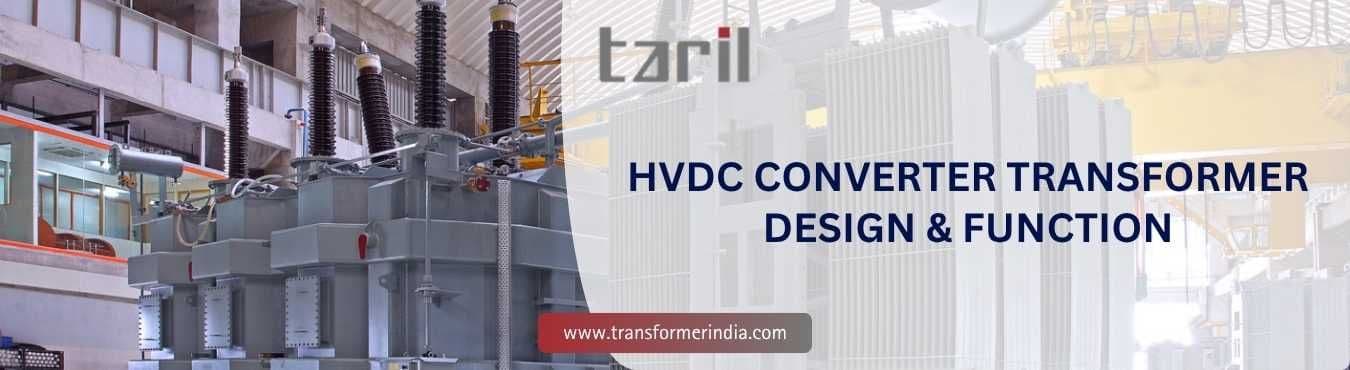
HVDC converter transformers play a crucial role in long-distance power transmission, particularly where traditional AC systems fall short. They help ensure the successful conversion of AC and DC currents, meeting modern energy requirements such as grid stability and renewable integration.
This blog gives insights into the components, design characteristics, and functions of HVDC converter transformers to help you understand the system better. With rising demand, HVDC transformer manufacturers in India and other global transformer manufacturers are advancing this technology.
Transformers, even though static components, are the heart of a reliable power system. They allow safe, efficient, and reliable power distribution and transmission.
However, when it comes to high-capacity and long-distance transmission, conventional AC (Alternating Current) systems generally fall short. Well, here's where the HVDC technology comes into picture. At its center is the HVDC converter transformer, successfully fulfilling the growing demand for renewable energy installation and efficient power transmission across the globe.
It wouldn't be wrong to call these HVDC systems the future of energy infrastructure. To ensure you have insight into these systems, this blog discusses the function and design aspects of HVDC converter transformers.
Before further due, let's get in!
An HVDC converter transformer is a special transformer acting as a power converter between alternating current (AC) and direct current (DC). It is often used in converter stations as a bridge between the HVDC transmission system and the AC grid.
In an HVDC system, power is first converted from AC to DC at the source, converted efficiently over long distances, and then converted back to AC at the receiving end. It is important to note that the HVDC converter transformer adjusts voltage levels and ensures compatibility between systems, playing a crucial role in the entire power distribution process.
HVDC converter transformer features a set of components, helping the equipment function as a unit throughout the power supply. The list includes:
The HVDC system comprises two terminals. Substations converting AC power to DC are rectifier terminals, whereas those converting DC to AC are inverter terminals.
Note that modern setups are designed to ensure that every terminal can perform both functions. Thanks to this design flexibility, they are together known as converter terminals. A standard HVDC system includes two terminals connected via a single HVDC transmission line.
The entire AC to DC conversion happens in converter stations using Graetz Circuits, which are nothing but three-phase bridge converters. Many HVDC systems rely on a 12-pulse converter, often formed by connecting two 6-pulse converters. This significantly improves efficiency while reducing harmonic distortion.
Converter valves are primarily responsible for the current conversion process. A lot of HVDC systems rely on thyristor-based valves, placed in a 12-pulse configuration.
These valves include several thyristor modules connected in series as per their voltage level. The valves are set up in valve halls and are cooled using several cooling methods, including water, oil, and air, to maintain safe operating temperatures.
The converter transformer connects the AC setup to the HVDC setup. It plays a crucial role in voltage isolation and conversion. The transformer's key features include 2 sets of 3-phase windings, valve side connected to the converter valves, and AC side connected to the busbar (grid).
Generally, one transformer uses a Y (Star) connection, and the other uses a Δ (Delta) connection. The entire arrangement helps with desired phase shifts and reduces harmonics. These transformers are specifically designed to cater to both AC and DC voltage stresses and harmonic currents.
Filters in the HVDC systems are used to control the effects of harmonics on both the AC and DC sides. This can include voltage resonance and instability, interference with the communication lines, and increased power losses. Three primary filters that the system relies on to cater to these effects are:
HVDC Converter transformers significantly rely on a reactive power source for appropriate functioning. Even though AC filters somewhat cater to these requirements, shunt capacitors, static VAR systems, and synchronous condensers provide additional support. The choice of source depends on response speed and system requirements.
This is a high-inductance component connected in series with the DC side of the converter. It significantly improves the system's stability by reducing the rate at which the current changes. Also, the reactor performs several important functions, such as:
The HVDC system pole includes transmission line components and converter station equipment. Overall, this represents one side, either negative or positive, of the HVDC system used during power transmission.
The HVDC converter transformer's design is more complex than that of a conventional transformer. It is because this transformer has to handle both AC and DC electrical stresses. Some key design characteristics of this converter transformer include:
The HVDC converter transformers are exposed to AC and DC voltages, both of which affect the insulation differently. Appropriate insulation design is important to ensure sustainable performance.
The common winding configurations include Star-Star and Star-Delta. They help achieve desired phase shifts (generally 30 degrees) essential for 12-pulse converter operation, ultimately reducing harmonics.
The converter transformer needs to withstand harmonic currents due to its non-linear converter operations. The high tolerance directly caters to increased heating and losses.
The HVDC's insulation system is enhanced and based on precise engineering and quality materials. This insulation is designed to handle high voltage gradients, DC bias, and temperature variations.
Due to the harmonics, these special converter transformers are at risk of experiencing higher losses. To curb and control the performance, having efficient cooling systems is essential.
Unlike conventional transformers, the HVDC converter transformers perform several complex functions. The most important ones are:
HVDC converter transformers step up (at inverter) or step down (at rectifier) the AC voltage to the desired levels with the help of converter valves.
The pair arrangement, one Start-Star and one Star-Delta, offering a 30-degree phase shift, is important for a 12-pulse converter operation. This focuses on canceling out the low-order harmonics (5th & 7th), leading to cleaner AC power.
This isolation prevents the interaction between DC and AC components by acting as a barrier between the AC system and the DC potential.
The reactance source limits short-circuit currents on the AC side, safeguarding the system during faults.
Converter transformers generally feature OLTC (On-Load Tap Changers), enabling a wide regulation range of the AC voltage. This helps control the converter's reactive power consumption.
The transformers are particularly designed to bear high harmonic current levels and high DC voltage potential of up to 1100 kV.
Thanks to the HVDC system's ability to withstand AC and DC stresses, ensure stability, and manage harmonics, they play a crucial role in the modern power infrastructure.
The HVDC technology is becoming important to meet modern electricity requirements and investing in these transformers ensures performance and reliability.
Why is HVDC technology preferred for long-distance transmission?
The HVDC converter transformers feature lower transmission losses. Additionally, they are efficient as compared to traditional systems for high-capacity and long-distance power transfer.
How is HVDC converter transformer different from conventional transformers?
Unlike traditional transformers, the modern-day HVDC converter transformer is designed to handle high harmonic levels, AC and DC voltage stresses, and complex operating conditions.
How does HVDC converter transformer support renewable energy?
The HVDC system enables efficient power distribution and transmission with the help of renewable sources like solar and wind.