August 25, 2026
5:35 min read

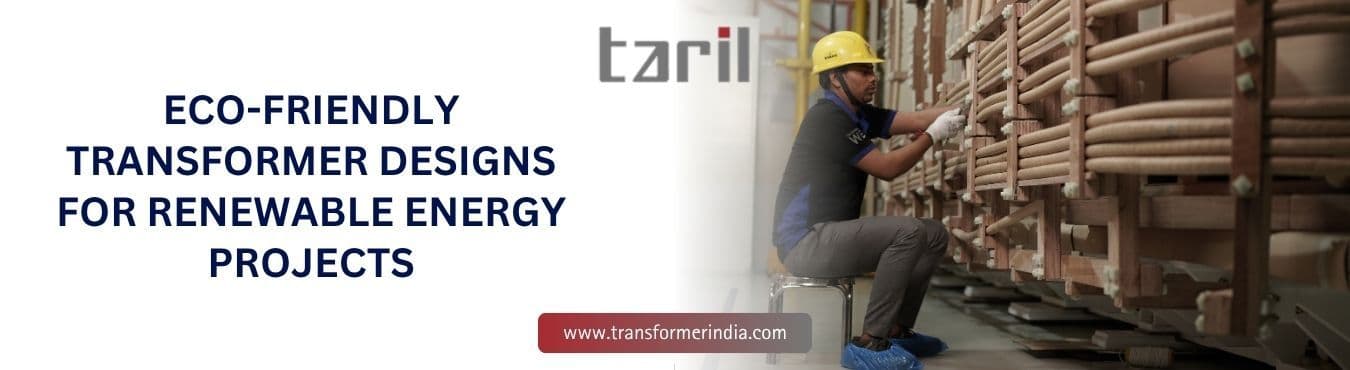
Eco-friendly transformer designs combine low electrical losses, responsible insulation choices, efficient cooling, condition monitoring, and lifecycle planning. This article explains how these design decisions apply to solar, wind, battery energy storage, green hydrogen, and industrial electrification projects. It also covers testing, standards, and the technical information required before selecting a transformer.
India’s renewable power system is growing at a scale that places greater responsibility on every part of the electrical network. As of 30 June 2026, the country had 288.59 GW of total renewable capacity, including large hydro, with solar accounting for 162.15 GW and wind for 57.44 GW.
This is where eco-friendly transformer designs become important. Their value does not come from a single material or technology. It comes from combining lower losses, suitable insulation, effective cooling, condition monitoring, and application-specific engineering.
Whether evaluating solutions from industrial transformer manufacturers or selecting a power transformer manufacturer for renewable projects, understanding these design choices is the first step towards choosing a transformer that performs reliably throughout the project lifecycle.
A transformer may remain energised for decades, so even modest losses continue to accumulate throughout its service life. No-load losses occur mainly in the core whenever the transformer is energised. Load losses rise with current and include winding resistance and stray load losses.
Sizing also matters. Oversizing can make no-load losses unnecessarily significant at light loading, while undersizing can increase thermal stress and load losses. Renewable installations add further design considerations:
A suitable design must balance efficiency with dielectric performance, temperature rise, short-circuit strength, overload duty, and maintainability.
Selecting the right transformer design reduces energy losses, improves reliability, and lowers environmental impact. Core materials, insulation systems, cooling methods, and monitoring technologies together determine long-term operational and sustainability performance.
Core material, lamination thickness, joint construction, and operating flux density influence no-load loss. High-grade CRGO steel remains common, while amorphous-metal cores may be considered where very low no-load loss is important. Bureau of Energy Efficiency guidance identifies amorphous-core distribution transformers as an energy-saving option, particularly at lower loading.
The winding design must also control resistance, leakage flux, eddy-current effects, and hot-spot temperature. Conductor area, transposition, cooling ducts, and mechanical bracing should be selected around the expected duty rather than the nameplate rating alone.
Natural ester fluid can reduce the environmental impact of a leak and improve fire performance in suitable installations. Its use still requires checks covering oxidation, moisture management, gasket compatibility, fluid processing, and operating temperature.
Natural-ester-filled transformers and reactors are available in TARIL's product portfolio for voltage ratings up to 400 kV.
Dry-type construction uses solid and air-based insulation instead of a liquid insulating medium. It can suit indoor facilities, battery buildings, and sites with strict spill controls. Liquid-filled transformers may remain preferable for higher ratings, outdoor service, or duties requiring greater cooling and overload capability.
Cooling should control winding hot-spot and top-oil temperatures without consuming unnecessary auxiliary power. Radiator area, oil circulation, fan staging, and pump control should match the real load cycle.
Useful condition data may include:
Monitoring does not eliminate failures, but it gives maintenance teams evidence to investigate abnormal trends earlier.
Renewable energy projects place different electrical and operational demands on transformers. Selecting the right design for solar, wind, battery storage, hydrogen, and industrial applications ensures efficiency, reliability, safety, and long-term performance.
Solar inverter transformers can face cyclic loading, harmonics, voltage variation, and high daytime temperatures. Wind projects may introduce rapid output fluctuations, humidity, vibration, and limited maintenance access.
A power transformer manufacturer should review converter data, grid-code obligations, fault level, impedance, reactive-power range, and loading profile before finalising the design. Generator step-up transformers used for the evacuation of renewable power also require careful attention to thermal reliability, short-circuit strength, and losses.
An auto transformer may suit systems with relatively close voltage levels where galvanic isolation is not required, and the earthing and protection studies support its use.
A battery energy storage system imports power while charging and exports power while discharging. Its transformer may therefore experience frequent changes in active power, reactive power, thermal loading, and direction of flow.
The Central Electricity Authority envisages 174 GW/888 GWh of storage by 2035-36, comprising 80 GW/321 GWh of battery energy storage and 94 GW/567 GWh of pumped storage. This scale makes harmonic studies, thermal cycling, reverse power flow, and protection coordination increasingly important.
An HVAC transformer may supply the control voltage required by ventilation, cooling, and building-management equipment within an energy-storage facility.
Electrolysers require controlled direct current. A rectifier transformer adjusts the incoming AC voltage, provides electrical isolation, and supplies the converter that produces the required high-current DC output.
Its pulse arrangement, phase displacement, secondary winding configuration, impedance, and cooling must be coordinated with the rectifier package. TARIL’s rectifier transformer range includes 6-pulse, 12-pulse and 24-pulse arrangements for high-current industrial applications.
India’s National Green Hydrogen Mission targets at least 5 million tonnes of green hydrogen production per year by 2030, supported by about 125 GW of additional renewable capacity.
Special transformers are required when standard designs cannot meet unusual winding, harmonic, dimensional, earthing, or environmental requirements. Converter-duty, earthing, and testing transformers are common examples. TARIL’s published range includes customised special transformers up to 100 MVA and 220 kV.
Arc furnace transformers operate under high secondary currents, rapid load changes, and severe electromechanical forces. Cooling performance, tap-changing duty, winding construction, and mechanical bracing are therefore central to reliable operation. TARIL manufactures arc furnace transformers for ratings up to 400 MVA and secondary currents up to 120 kA.
Indian projects commonly refer to applicable BIS and IEC standards, relevant Central Electricity Authority regulations, and project-specific requirements.
The technical schedule should define:
BEE’s standards and labelling framework for distribution transformers links star levels to notified energy-consumption standards and permits verification testing. This reinforces the need to specify measurable losses rather than rely on broad efficiency claims.
Before approaching industrial transformer manufacturers, the project team should define the voltage ratio, MVA requirement, vector group, impedance, and tap range. It should also provide the load profile, harmonic spectrum, site conditions, fault level, cooling preference, and overload duty.
A capable power transformer manufacturer should explain how the proposed design manages:
Purchase price should be considered alongside capitalised losses, auxiliary consumption, outage exposure, maintenance access, and expected service life. The right transformer is the one designed for the project’s real electrical and environmental duty, not simply the lowest initial quotation.
An eco-friendly transformer is not defined by one fluid, core material, or efficiency figure. It results from coordinated electrical, thermal, mechanical, and environmental engineering.
For India’s expanding renewable, storage and green hydrogen systems, careful loss specification, complete converter data, verified testing and planned maintenance are essential. Together, these decisions create a transformer that is environmentally responsible, technically dependable, and easier to manage throughout its working life.
For projects that require application-specific transformer engineering, TARIL can support the design process with solutions developed around the project’s electrical duty, operating environment, and long-term performance requirements.
What Is the Difference Between an Efficient and an Eco-Friendly Transformer?
An efficient transformer focuses mainly on reducing electrical losses. An eco-friendly design also considers insulating media, fire and spill risks, maintenance, repairability, service life, and material recovery.
Are Amorphous-Core Transformers Suitable for Every Renewable Project?
No. They can reduce no-load loss in suitable applications, but size, rating, mechanical construction, cost, noise, and the operating profile must also be evaluated.
Is a Dry-Type Transformer Always Better Than a Liquid-Filled Transformer?
No. Dry-type units can suit indoor or fire-sensitive locations, while liquid-filled units may be better for higher ratings, outdoor operation, and demanding cooling duties.
What Information Should Be Shared With the Transformer Manufacturer?
Provide the voltage ratio, capacity, vector group, impedance, tap range, converter details, harmonic spectrum, load cycle, ambient conditions, altitude, fault level, and applicable standards.
How Do Harmonics Affect Transformer Performance?
Harmonic currents can increase winding and stray losses, raise temperature, and add stress to the insulation system. The transformer should therefore be assessed using the project-specific harmonic spectrum.
Can an Existing Transformer Be Made More Sustainable?
In some cases, improved monitoring, cooling-system maintenance, oil treatment, refurbishment, or life-extension work can improve performance. A detailed condition assessment should be completed before selecting any intervention.