Introduction
What enables an electric arc furnace to generate enough heat to melt steel efficiently? The answer lies in a specialized power system that can supply enormous electrical current under conditions that can change within seconds.
At the center of that system is the arc furnace transformer. Unlike a conventional transformer, it must withstand frequent switching, sudden load fluctuations, repeated short-circuit stresses, and continuous thermal loading. Its ability to provide the required voltage and current under changing furnace conditions directly affects melting performance, energy efficiency, equipment reliability, and production continuity.
What Are Arc Furnace Transformers?
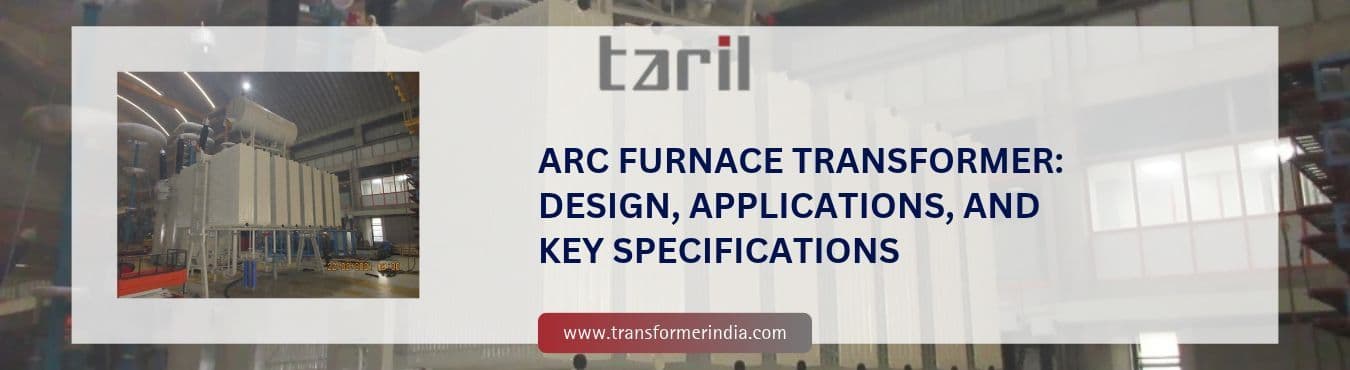
An arc furnace transformer is a specially designed step-down transformer that supplies the low voltage and very high current an electric arc furnace needs. Inside the furnace, electrodes create an electric arc that produces intense heat. This heat melts scrap steel, direct-reduced iron, or other metallic materials.
The furnace’s power requirements change throughout each production stage, from the initial bore-down to melting and final refining. The transformer uses voltage regulation and tap-changing arrangements to adjust the secondary voltage as furnace conditions change, helping provide the voltage and current conditions required throughout the melting cycle.
How Is an Electric Arc Furnace Transformer Designed?
Effective electric arc furnace transformer design depends on the furnace’s complete operating profile, not only its MVA rating. Engineers consider the required current, secondary voltage range, impedance, melting time, overload conditions, tap-changing frequency, and production targets.
Mechanically Reinforced Windings
High and rapidly changing currents create powerful forces inside the transformer. The windings must be securely supported to prevent movement, deformation, and insulation damage during repeated furnace cycles.
Conductors must also be arranged to distribute current evenly. Uneven distribution can create hot spots and place excessive mechanical stress on parts of the winding.
Voltage Regulation and Impedance
Each stage of steelmaking requires a different balance of voltage and current. A tap-changing system adjusts the secondary voltage for arc initiation, melting, refining, and temperature control.
Impedance influences the current available during unstable furnace conditions and helps limit excessive fault current. If it is too low, excessive current may pass through the system. If it is too high, the furnace may receive insufficient power, leading to longer melting times. An internal or external series reactor may be added to improve arc stability.
Cooling and Thermal Control
Furnace operation generates heat in the windings, terminals, tap changer, and other transformer components. Depending on the transformer’s rating and duty cycle, cooling may use natural oil circulation, forced air, forced oil, or an oil-to-water system.
Large transformers may also use water-cooled low-voltage terminals. The cooling arrangement must keep temperatures within specified limits during normal operation and any permitted overload conditions.
Secondary Connections and Insulation
The transformer’s low-voltage side may carry tens of thousands of amperes. Keeping the secondary connections short and properly arranged helps reduce electrical losses, current imbalance, and unwanted heating between the transformer and furnace.
The insulation must withstand repeated temperature changes, harmonic currents, switching events, and voltage disturbances. The core, tank, and clamping components must also be designed to limit losses caused by stray magnetic flux.
Where Are Arc Furnace Transformers Used?
The primary application is steel production, where an electric arc furnace melts scrap or other iron-bearing feedstock. Related furnace-transformer designs are also used in:
- Ladle refining furnaces
- Submerged arc furnaces
- Ferroalloy and ferrosilicon plants
- Non-ferrous metal smelting
Each process creates a different load profile. A scrap-melting furnace experiences rapid and irregular current changes, while a submerged arc furnace may operate more continuously. The transformer must therefore match the actual furnace process rather than a general catalog rating.
Which Specifications Should Buyers Check?
Before approaching a furnace transformer manufacturer in the USA, buyers should prepare a complete furnace-duty profile.
| Specification | Why it matters |
|---|---|
| Rated MVA | Establishes continuous power capability |
| Primary voltage | Matches the incoming plant supply |
| Secondary voltage range | Supports different furnace stages |
| Maximum current | Defines winding and terminal requirements |
| Impedance | Influences arc stability and fault current |
| Tapping range | Controls voltage during the melt |
| Duty cycle | Defines loading and overload conditions |
| Cooling method | Controls operating temperature |
| Frequency and phases | Ensure electrical-system compatibility |
| Applicable standard | Defines design and testing requirements |
| Site conditions | Influence cooling, insulation, and equipment design |
Buyers should also provide expected heats per day, melt duration, electrode arrangement, cooling-water conditions, low-voltage connection layout, protection requirements, and delivery schedule. Testing should cover electrical losses, impedance, insulation strength, temperature rise, ratio, phase displacement, and agreed functional checks.
How Should Buyers Evaluate a Manufacturer?
Companies comparing global transformer manufacturers should look beyond maximum catalog ratings. The manufacturer should demonstrate experience with a comparable furnace type, current level, voltage range, production cycle, and cooling arrangement.
Buyers should request reference projects, short-circuit withstand evidence, guaranteed losses, temperature-rise limits, tap-changer details, testing scope, and information about commissioning and spare-parts support.
Price comparisons should therefore begin only after confirming that each supplier can meet the complete furnace duty.
Conclusion
Arc furnace transformers influence arc stability, melting time, electrical losses, equipment availability, and production output. Its windings, impedance, tapping range, cooling system, connections, insulation, protection, and testing must reflect the actual operating cycle.
TARIL develops furnace transformer solutions for steel, smelting, and other heavy industrial applications. Share your furnace data, electrical requirements, duty cycle, and site conditions with TARIL to discuss a transformer design matched to your application.
FAQs
What does an arc furnace transformer do?
An arc furnace transformer steps down grid voltage and supplies extremely high, controllable current to furnace electrodes. The resulting electric arc produces the heat required to melt scrap steel or refine molten metal.
How is an arc furnace transformer different from a power transformer?
A power transformer generally serves more stable AC loads, while an arc furnace transformer is specifically designed to handle rapidly changing loads, high currents, thermal cycling, harmonics, and the mechanical stresses associated with furnace operation.
How is an arc furnace transformer rating selected?
The rating depends on furnace capacity, melt cycle, incoming voltage, secondary voltage, maximum current, impedance, cooling method, overload profile, tapping range, harmonics, installation conditions, and the required production target for each heat cycle.
Which cooling method is used for furnace transformers?
Forced-oil and oil-to-water cooling arrangements are often used for larger furnace transformers because of their high losses and demanding thermal duty. The correct method depends on rating, duty cycle, site conditions, reliability, and operational requirements.
What information should buyers provide to a manufacturer?
Buyers should provide furnace type, required MVA, primary and secondary voltages, current range, impedance, tapping duty, cooling preference, expected melt cycle, applicable standard, ambient conditions, layout constraints, and protection requirements for accurate design.