
August 25, 2026
5:35 min read

This article outlines the ten most frequently documented causes of power transformer failure, based on a published CIGRE reliability study, and reviews the maintenance and manufacturing practices that help lower the risk of unplanned outages.
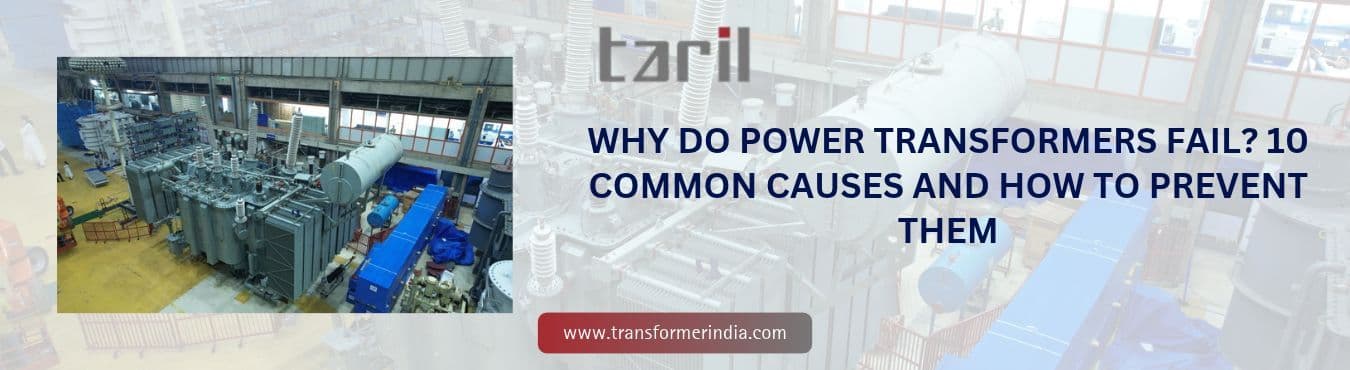
Transformer failure can often follow a gradual build-up of stress inside one or more components — insulation, windings, bushings, or the tap changer — long before an outage actually occurs. Because a power transformer sits at the centre of every substation and industrial power network, its failure rarely stays contained to one asset; it can interrupt supply to an entire feeder or plant. Understanding why these failures happen, and which components are involved most often, is the first step toward reducing them. The sections below draw on published reliability surveys to answer a simple but important question: what actually causes a transformer to fail?
A CIGRE reliability survey provides useful data on where transformer failures originate. It covers transformers rated 100 kV and above between 1996 and 2010 found that on-load tap changers accounted for 31% of failures, followed by high-voltage windings at 19% and bushings at close to 14%. The exact proportions can vary by transformer type, voltage class, and operating conditions. Based on this research and commonly reported transformer failure mechanisms, the following are ten important causes and contributing factors:
Mechanical wear, contact erosion, and oil carbonisation inside the tap changer compartment are consistently reported as one of the leading failure categories in CIGRE surveys.
CIGRE's Working Group A2.43 notes that bushings are responsible for roughly a quarter of transformer failures on average, making them one of the most significant contributors to transformer failure.
short circuits and other faults can generate strong mechanical forces that displace or damage the windings, weakening the transformer over time.
oil-paper insulation degrades gradually through thermal aging and oxidation, reducing dielectric strength over time.
moisture entering the oil-paper system accelerates insulation ageing and increases the risk of dielectric breakdown.
sustained loading beyond nameplate rating raises winding hot-spot temperatures and shortens insulation life.
poor internal or external connections generate localised heating that can progress to a fault if undetected.
transient overvoltages from lightning strikes or switching operations can impose stresses well above normal levels and, without adequate surge protection, progressively weaken or puncture insulation.
irregular oil testing and dissolved gas analysis can allow developing faults to go undetected until they escalate.
defects introduced at the design or build stage can shorten a transformer's service life if they are not identified before it enters service.
None of the causes above act entirely in isolation; ageing insulation, for instance, makes a unit more vulnerable to a surge that a newer transformer might tolerate without damage. Prevention tends to work best as a combination of monitoring, maintenance, and sound original build quality, rather than any single measure.
Condition-based monitoring - dissolved gas analysis, oil quality testing, and infrared scanning can flag insulation or connection issues before they cause an outage.
Maintenance aligned to manufacturer guidance - testing and servicing intervals vary by transformer type, loading history, site conditions, and manufacturer recommendation, so schedules should be set per unit rather than applied as a blanket rule.
Surge protection - properly rated lightning and switching surge arresters reduce the risk of insulation puncture from transient overvoltages.
Load management - keeping loading within nameplate limits, or within utility-approved emergency ratings, helps control hot-spot temperatures.
Quality-controlled manufacturing - design review, factory inspection, and electrical testing prior to dispatch help identify manufacturing or design issues before the transformer is put into service.
Because several of the failure modes described above originate at the design or build stage, the choice of manufacturer has a direct bearing on long-term reliability. Buyers sourcing an electrical transformer are generally better served by facilities that follow documented design review, inspection, and testing protocols aligned with international standards such as IEC and ANSI.
Reliable power transformer suppliers typically make their type-test certificates and quality records available, which gives a buyer a way to verify build quality before a unit is dispatched. This is a useful check regardless of where the transformer is manufactured, including for organisations comparing options among global transformer manufacturers for a large or cross-border project. Buyers evaluating transformer manufacturers in the USA also tend to look for the same documentation, since the transformers face many of the same loading and environmental considerations as those used elsewhere. The same principle applies when assessing power transformer installations in the USA before selecting a supplier.
What is one of the most common causes of power transformer failure?
In the cited CIGRE reliability survey, on-load tap changer faults were one of the leading failure categories, followed by winding and bushing-related failures.
Can a failing transformer be identified before it fails completely?
In many cases, yes. Dissolved gas analysis, oil testing, and thermal imaging can detect developing faults in insulation, connections, or the tap changer well before a complete failure occurs.
Does overloading always cause immediate failure?
Not necessarily. Occasional overloading within a manufacturer's emergency rating may not cause immediate damage, but sustained overloading accelerates insulation ageing and shortens service life over time.
How often should a power transformer be tested?
Testing intervals depend on the transformer's type, age, criticality, and operating environment, so schedules are generally set according to manufacturer guidance rather than a single fixed rule.