October 19, 2026
4:45 min read

This article compares a rectifier transformer with a power transformer, covering their purpose, electrical duty, design considerations, applications, and the factors buyers should consider before selecting either transformer.
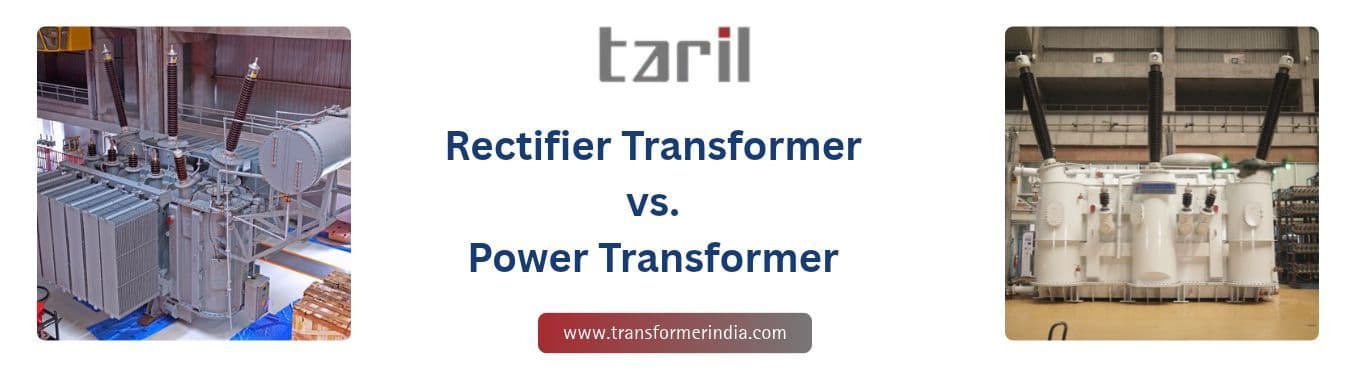
At first glance, a rectifier transformer and a power transformer may seem similar because both change voltage levels. The difference matters when the transformer is feeding a specialized industrial process rather than a conventional AC power network.
A rectifier transformer works as part of a system that uses AC-to-DC converters to convert alternating current into direct current. So, what actually separates the two?
A rectifier transformer supplies Power to a rectifier system, where AC electricity is converted into DC electricity. The rectifier stage may use devices such as diodes or thyristors, depending on the application.
These transformers are commonly used where a process needs controlled DC power, including:
This is why a rectifier transformer is designed around the complete conversion system rather than treated as a standard transformer with a rectifier connected afterward.
A power transformer primarily transfers electrical power between different voltage levels within an AC power system.
Think of it as part of the infrastructure that moves electricity from where it is generated to where it needs to be transmitted, distributed, or consumed.
Typical applications include:
Its design focuses on requirements such as voltage ratio, insulation, thermal performance, efficiency, mechanical strength, and short-circuit withstand capability. For example, TARIL's product portfolio includes power transformers up to 500 MVA and 1200 kV class.
The key differences become clearer when you compare their purpose, electrical duty, operating conditions, and typical applications.
| Parameter | Rectifier Transformer | Power Transformer |
|---|---|---|
| Primary role | Feeds a rectifier system | Transfers AC power between voltage levels |
| Output requirement | Supports AC-to-DC conversion | Remains within an AC power system |
| Typical duty | Specialized industrial processes | Generation, transmission, and grid applications |
| Key concerns | Current, harmonics, phase shifting, and process variation | Voltage, insulation, thermal, and short-circuit performance |
| Typical applications | Electrolysis, metals, hydrogen, and other DC processes | Power plants, substations, and transmission networks |
The important point is that the difference is not simply about voltage. The transformer's electrical duty determines how it needs to be designed and tested.
The application determines the transformer’s electrical duty, operating conditions, and design priorities. Here’s how those requirements differ between rectifiers and power transformers.
A rectifier transformer must work closely with the connected conversion equipment. Harmonic currents, high-current operation, phase relationships, and process variations can all influence the design.
For applications such as electrolysis or metal processing, the transformer must reliably supply the AC power required by the rectifier system across its operating range.
This makes experience with specialized industrial loads important when comparing transformer rectifier manufacturers.
Power transformers operate within larger electrical networks, so their design has to address high voltage levels, insulation coordination, thermal performance, mechanical stresses, and fault conditions.
The required voltage class and capacity also vary significantly between projects. A transmission substation, for example, can have very different requirements from a smaller industrial installation.
The choice depends on the electrical system and the job the transformer needs to perform. A rectifier transformer is selected when the system requires AC-to-DC conversion, while a power transformer is used to transfer AC power between different voltage levels. The selection should therefore be based on the application, electrical duty, and operating conditions.
Before choosing between a rectifier transformer and a power transformer, evaluate:
For buyers searching for power transformers in the USA, comparing suppliers only by MVA rating may not be enough. Project experience, testing capability, voltage class, application knowledge, and the ability to meet specific electrical requirements should also be considered.
The difference between a rectifier transformer and a power transformer comes down to the job the transformer needs to perform. One supports specialized AC-to-DC industrial processes, while the other primarily supports AC power transfer across electrical networks.
Planning a rectifier or power transformer for your project? Talk to TARIL’s transformer experts to discuss your electrical requirements and explore a transformer solution suited to your application.
What is the main difference between a rectifier transformer and a power transformer?
A rectifier transformer supplies power to a rectifier system that converts AC into DC. A power transformer transfers AC electrical power between different voltage levels in power generation, transmission, and industrial systems.
Where are rectifier transformers commonly used?
Rectifier transformers are used in industrial processes that need controlled DC power, including electrolysis, metal processing, hydrogen production, and other applications where AC power must reliably and continuously feed conversion equipment during operations.
Where are power transformers commonly used?
Power transformers are commonly used in generation plants, substations, transmission networks, grid interconnections, and large industrial systems where electrical Power must be transferred between different voltage levels efficiently and reliably under demanding conditions.
How do I choose between a rectifier transformer and power transformer?
Start with the application's voltage, current, load profile, harmonics, regulation needs, short-circuit requirements, and operating environment. Then select a transformer designed for that electrical duty and application requirements to ensure reliable operation.