October 19, 2026
4:45 min read

Australian mine sites rely on a mix of power transformers, distribution transformers, dry-type transformers and oil-filled transformers, each suited to a different part of the site's electrical network and to the demanding conditions mining environments create. This article looks at how these transformer types are actually selected and used on Australian mining operations, and what to weigh up when sourcing from transformer suppliers who understand mining loads.
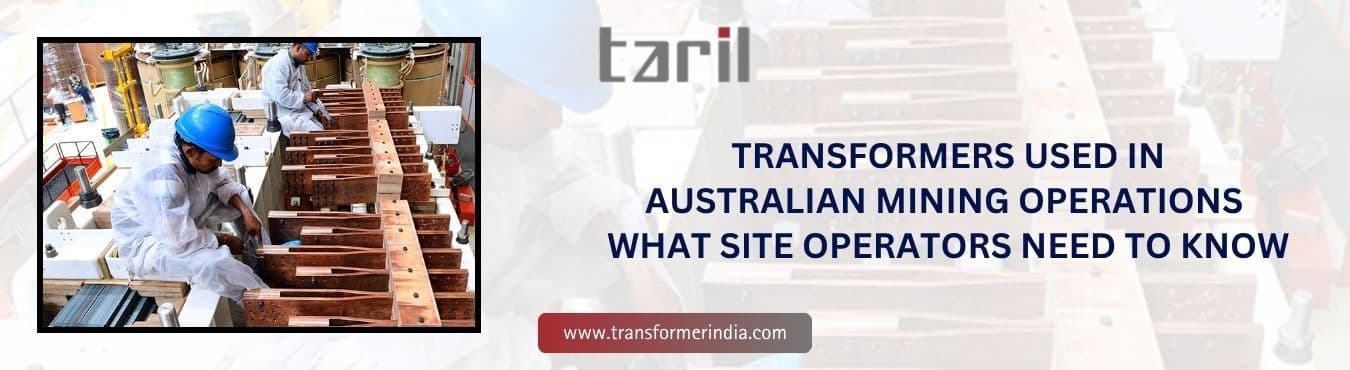
Anyone who has spent time on a Pilbara iron ore site or a Bowen Basin coal operation knows the electrical network is never an afterthought. Draglines, crushers, conveyors, ventilation fans and processing plants all pull enormous, often erratic loads, and every one of those loads has to be stepped up or down somewhere along the line. Get the transformer selection wrong - the wrong cooling method, the wrong impedance, the wrong enclosure rating for a dusty pit - and you're looking at unplanned downtime that costs far more than the equipment itself.
Crushing and grinding circuits can vary significantly with ore hardness and throughput, demand spikes can occur where electric haulage equipment and charging infrastructure are used. Remote sites often run partly or entirely through microgrids rather than the main grid. Australian mining regions also present challenging conditions, including high ambient temperatures, fine dust, monsoonal humidity in the Top End, and vibration from blasting and heavy equipment.
This is why transformers specified for Australian mining need to be built, and rated, for conditions well outside a standard industrial spec sheet.
Power transformers sit at the top of the chain, stepping voltage up for transmission from the grid connection (or on-site generation) to the mine's main substation, and stepping it back down to a level the site's distribution network can use. Because a failure here can affect the whole site rather than just one section, selection typically weighs impedance, cooling method (ONAN, ONAF, or forced cooling for higher loads) and short-circuit withstand capability alongside the more obvious kVA rating, and redundancy or preventive maintenance schedules for power transformers tend to be stricter than for equipment further down the network.
Once power reaches the site substation, distribution transformers break it down further to feed individual work areas - the processing plant, workshops, camp accommodation, pump stations and so on. Sizing them correctly matters: undersized units overheat under peak crushing loads, while oversized ones waste capital and run less efficiently at partial load.
Dry-type transformers don't use a liquid coolant, which is why they're often considered where reducing liquid-fire risk or environmental exposure is a priority - underground workings, enclosed switchrooms, and areas near conveyors carrying combustible material are typical examples. That said, dry-type isn't automatically the right call for every safety-sensitive location - the final choice depends on the specific installation, the rating required, available cooling and ventilation, space constraints, and whatever mining-specific requirements apply to that part of the site, so it's worth working through with whoever is specifying the installation rather than assuming underground automatically means dry-type.
Oil-filled transformers remain the default for high-capacity, continuous-duty applications across open-cut and large processing operations, largely because the oil does double duty as both coolant and insulator, allowing higher loading in a smaller footprint. Dissolved gas analysis (DGA) is commonly used to monitor the condition of critical oil-filled transformers in mining operations, as it can help identify developing faults such as arcing, overheating or insulation problems before they lead to failure. Given how remote many sites are, that early warning is often the difference between a scheduled swap-out and a multi-day production stoppage.
A few factors set Australian conditions apart from mining regions elsewhere:
Not every supplier that sells general industrial transformers understands mining duty cycles, and that gap tends to show up later as premature failures or units that can't actually handle the site's real load profile. When evaluating transformer suppliers for a mining project, the practical factors worth working through include:
1. Duty cycle and load profile matching - mining loads can vary significantly, so it's worth confirming the supplier has sized the unit against actual expected load swings, not just a nameplate average 2. Environmental and enclosure ratings - thermal, dust and vibration ratings appropriate to the specific installation location, checked against the manufacturer's data rather than assumed 3. Compliance with relevant Australian and international standards for the voltage class and application involved 4. Realistic lead times - transformer manufacturing and shipping can involve long lead times, and mine project schedules rarely have that much slack built in 5. After-sales support - oil testing, spare parts availability, and technical backup, which matters more on remote sites where a callout can mean days of travel rather than hours
It's increasingly common to source and specify equipment digitally before a physical site visit ever happens. Being able to buy transformers online Australia-wide, or at least request detailed technical quotes and specifications online, saves procurement teams real time. That said, for anything above a fairly modest capacity, most mining operators still want direct technical consultation before finalising an order, simply because the load profile and site conditions are rarely identical from one operation to the next.
**What is the difference between a power transformer and a distribution transformer on a mine site? **
Power transformers handle bulk transmission at higher voltages, typically between the grid or generation source and the main substation. Distribution transformers step that power down further to supply individual site areas like the plant and workshops.
Are dry-type transformers safe to use underground?
They're often a good fit for underground and enclosed spaces because they avoid the liquid-fire risk that comes with oil, but suitability still depends on the specific application - rating, ventilation, space and the site's own mining requirements all need to be checked rather than assuming dry-type is automatically the right choice for every underground installation.
How often should oil-filled transformers be tested on a mine site?
Dissolved gas analysis is often carried out on a scheduled basis, with the frequency depending on the transformer's criticality, condition and age.
Why does dust matter so much for transformer selection in Australia?
Fine dust can degrade insulation and clog cooling paths over time, which is why enclosure ratings and sealing are treated as a core spec item, not an add-on, for Australian mining projects.
Is it possible to get a mining transformer quote without an on-site visit?
For standard specifications, yes - many suppliers can quote from load data and site parameters supplied remotely.
Looking for transformer solutions built for demanding mine-site conditions? Get in touch with TARIL to discuss your site's power, distribution, dry-type or oil-filled transformer requirements.